Noisy Deadlines

Productivity

This is a series of posts with reading notes of the book “Getting Things Done: The Art of Stress-Free Productivity” by David Allen.

My notes on Chapter 4 – Getting Started: Setting Up the Time, Space, and Tools

This chapter gives some tips and tricks to get started with the capturing process.

The first thing is to acknowledge that we need time for this. David recommends a weekend or holiday to avoid external disturbances. It will be intense if you're doing it for the first time!

Dedicate two days to this process, and it will be worth many times that in terms of your productivity and mental health. — David Allen

Setting up the space

The second thing to do is to set up a space, in your home and at the office (if you work in one). Have a central space to serve as your “central cockpit of control”, it might be your work office, your home office, any space with the basics:

  • a writing surface
  • an in-tray
  • space for digital tools/computer/laptop if you use one

Also, if we go to an office during work hours, we will still need a space at home. I have a work office (I don't work from home) and a home office, so I have in-trays in both locations.

A side note: I remember when the pandemic started, and I had to work from home during the lockdowns, it was an easy transition. I already had a desk with space for a computer and an office chair at home, while some people really struggled those first months to try to find a space at their homes and set up something. So, thanks, GTD! 👍

Another point is that the space at home doesn't need to be a separate room, it can be a corner where you can fit a desk and a chair to work from. For some years, when I was living in a tiny 1-bedroom apartment, I had my desk on a corner inside the bedroom (right beside my bed!). It worked!

Tools

David Allen then lists what we need to complete the setup: in-trays, stack of plain letter-sized paper, pen/pencil, post-its, paper clips, stapler, scotch tape, rubber bands, an automatic labeller, file folders, a Calendar, wastebasket, devices and notebooks.

From all those items, I think the only one I don't have at all are rubber bands. Oh, I also don't keep a stack of plain paper (I don't have a printer). I use a small spiral notebook as my paper capturing tool. I've only recently acquired a labeller, and it is very satisfying to have things labelled in a nice font. Though I still have to replace my handwritten reference archive labels using my new labeller.

There is a discussion about where to keep the lists. We can do it the “low-tech” way: pieces of paper kept in a folder, or we could go “mid-tech” with loose-leaf notebooks or paper planners, or we can be “high-tech” with our lists in a to-do app. I'm mostly high-tech for my lists: I use a digital calendar and an app (Nirvana).

“Keep in mind, though, that the tool you use will not give you stress-free productivity. That is something you create by implementing the GTD method.” — David Allen

Filing System

Non-actionable but potentially relevant material should be organized in a general-reference file system. These files are: articles, brochures, notes, printouts, manuals, documents, membership cards, etc. Having a dedicated space to store those items avoids the uncertainty and anxiety of figuring out where to store them. If they don't have a home, they will start accumulating in horizontal surfaces, creating clutter and “psychological noise”.

The filing system has to be easy, fast and fun to use. It's also good to make sure we are not storing unnecessary duplicates (a hard copy of something we only access though the Web, for example).

“In the fire zone of real work, if it takes longer than sixty seconds to file something where it belongs, you won't file, you'll “stack.” — David Allen

David recommends using one A to Z alphabetical physical filing system. For the digital systems, he also recommends the A-Z approach.

My physical references are sorted alphabetically, as recommended. But my digital files have always been organized in major “life topics”. I don't know why or how, but I came up with these folders way before I knew what GTD was. I still have them more or less unchanged for 12+ years:

  • 1 Education
  • 2 Finances
  • 3 Fun and Interests
  • 4 Personal
  • 5 Work
  • 6 Home
  • 7 Reference
  • 8 Photos Archive

The last good practice is to purge our files (digital and physical) at least one a year. I usually take a look at my physical files and recycle some things that are longer current or useful. I have a very small file storage drawer, and I like to keep most of my paperwork in digital form anyway.

Now, I never really purge my digital files because I don't have the issue of lack of storage. I focus on keeping things organized in their folders, and that's enough for me.

My Space at Home

Here is my setup at home:
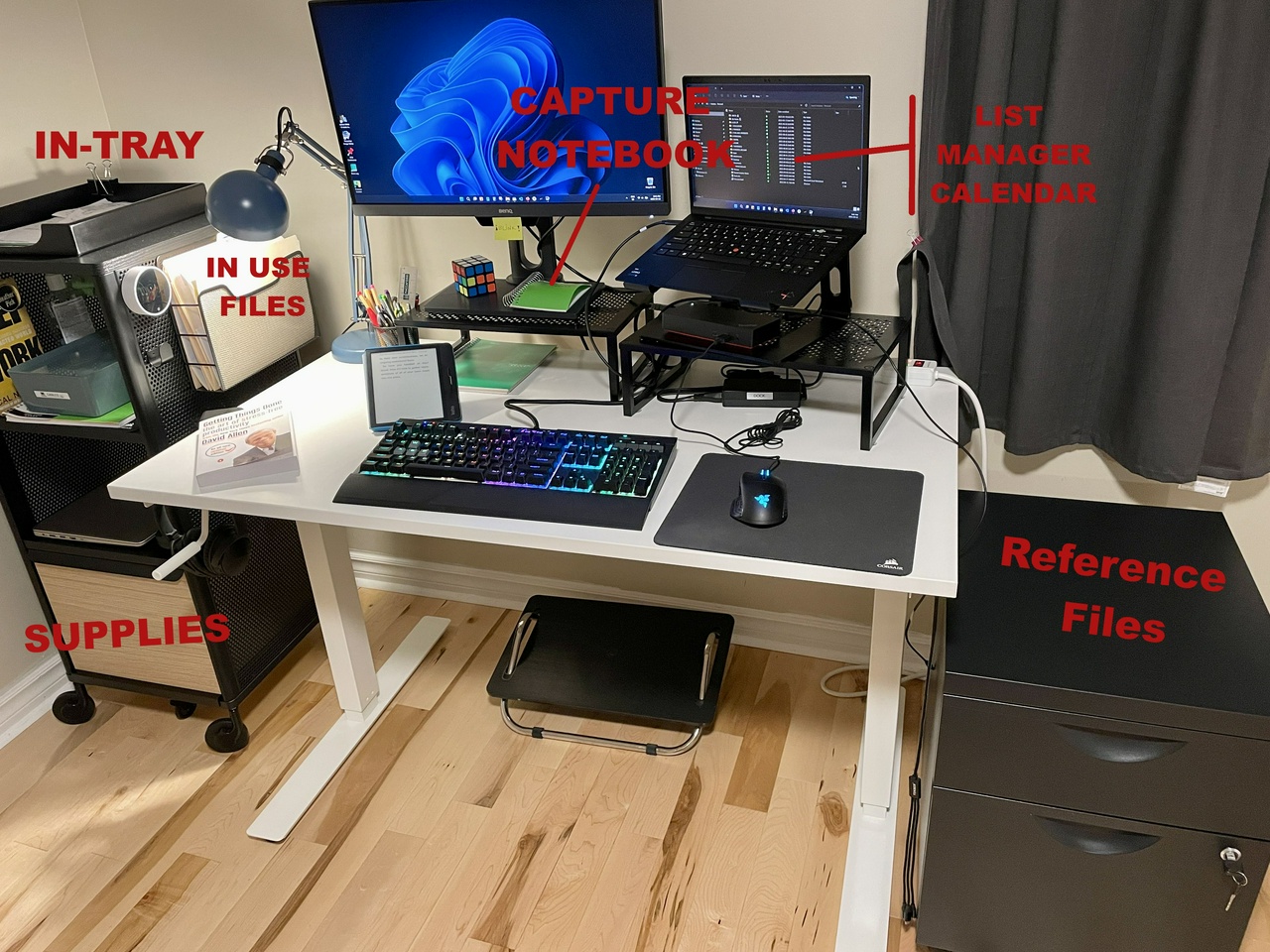
I'm happy with my space, it has everything I need close at hand. For some years (in the tiny apartment) I didn't have the storage space on the left, so my in-tray was on top the file drawer cabinet on the right.


The next chapter is about capturing stuff. So after we have a space set up, we can start with Step 1: Capture.

-- Post 32/100 of 100DaysToOffload challenge! #100DaysToOffload #100Days #productivity #GTD #GTDnotes

Thoughts? Discuss... if you have a Write.as account or Reply by email


By Noisy Deadlines Minimalist in progress, nerdy, introvert, skeptic. I don't leave without my e-reader.

This is a series of posts with reading notes of the book “Getting Things Done: The Art of Stress-Free Productivity” by David Allen.

My notes on Chapter 03: “Getting Projects Creatively Under Way: The Five Phases of Project Planning”

This chapter presents the Natural Planning Model, which is a powerful tool to be used as needed. It is not supposed to be complicated or formal, it describes what our brains naturally do all the time when trying to get a project under control.

Natural Planning Model – 5 Steps:

  1. Defining purpose and principles: why you want to do this? what is your intention?

  2. Outcome visioning: what a successful outcome would look like? => this defines the project name

  3. Brainstorming: ideas on how to accomplish it

  4. Organizing: what is the sequence/priorities of events? What are the components?

  5. Identifying next actions: what is the first next action?

“You have an urge to make something happen; you image the outcome; you generate ideas that might be relevant; you sort those into a structure; and you define a physical activity that would begin to make it a reality. And you do all of that naturally, without giving it much thought.” — David Allen

Another nice insight is the “unnatural planning model”. It's common to see situations where someone leading a meeting will ask, “Now, who has some good ideas?”. That's not ideal because it will make people critique ideas before they are even externalized. It's better to go with brainstorming, with absolute no judgment of ideas.

Read more...

This is a series of posts with reading notes of the book “Getting Things Done: The Art of Stress-Free Productivity” by David Allen.

My notes about Chapter 02 – Getting Control of Your Life: The Five Steps of Mastering Workflow

This chapter presents the Five Steps and explains the main elements of each one.

In summary, the five steps represents the following workflow:

1. Capture what has our attention;

2. Clarify what each item means and what to do about it;

3. Organize the results, which presents the options we...

4. … Reflect on, which we then choose to...

5. … Engage with.

It’s very logical, and it cognitively resonates with my mind. I notice that if I skip some steps or try to do it all at once, I don’t have a clear understanding of what I need to do. And that leads to unclear next actions, a lack of clarity to determine what is the best use of my time, and complete overwhelm.

“I have discovered that one of the major reasons many people haven't had a lot of success with getting organized is simply that they have tried to do all five steps at one time.” — David Allen

Some major takeaways from this chapter

For each of the steps, there is a clear explanation of what they mean and what are the success factors for each one.

Read more...

This is a series of posts with reading notes of the book “Getting Things Done: The Art of Stress-Free Productivity” by David Allen.

My notes about the first chapter: “A New Practice for a New Reality”

The first chapter of the book discusses the problems we have today as knowledge workers. We are living in a reality with constant new demands and no clear boundaries. Work tasks can be often ambiguous, and we have to figure out for ourselves how to execute them, while being bombarded with information.

One of the key aspects of the method is to manage all of our open loops. Everything, mental or physical, that has come to our attention and that we have not yet determined their meaning, is considered to be “Stuff”. Stuff comes through life's random inputs: emails, calls, invites, demands, ideas, conversations, bills, etc, etc.

So, mismanaged open loops will pull at our attention if not managed appropriately. I find that to be painfully true. This was my first “a-ha” moment when I read the book 11 years ago. I was keeping everything in my head, and I couldn't understand why I was feeling so overwhelmed and stressed.

David Allen explains why keeping things in our heads is NOT ideal:

A big problem is that your mind keeps reminding you of things when you can’t do anything about them. It has no sense of past or future. That means as soon as you tell yourself that you might need to do something, and store it only in your head, there’s a part of you that thinks you should be doing that something all the time. Everything you’ve told yourself you ought to do, it thinks you should be doing right now. — David Allen

I have that feeling every time I don't write things down. And, as David Allen points out, the reason why things are on my mind can be:

  1. I haven't clarified exactly what the intended outcome is

  2. I haven't decided what the next physical action step is

  3. I haven't put reminders of the outcome and the action required in a system I trust

The starting point to reduce overwhelm is to capture and organize all the “Stuff”. That way, we can start building an inventory of next actions that can be implemented or renegotiated. It requires us to define what “done” means and what “doing” looks like.

What I really like about this book is that it really goes into the nitty-gritty on HOW to capture and organize all that “stuff” (to be covered in the next chapters). And the method includes (and integrates) both personal and professional areas: it is really a full life management system.

In the end, the promise is to have “Mind Like Water” or be in the “Zone”, in a state of perfect readiness. The image behind this analogy is imagining throwing a pebble into a still pond:

How does the water respond? The answer is, totally appropriately to the force and mass of the input; then it returns to calm. It doesn’t overreact or underreact. Water is what it is, and does what it does. It can overwhelm, but it’s not overwhelmed. It can be still, but it is not impatient. It can be forced to change course, but it is not frustrated. — David Allen

I can say from experience that I had mornings and afternoons in which I was in the “Zone”. It's when I have a clear image of what needs to be done, I have well written next actions and my mind feels free to prioritize things and focus.

But this was just the introduction. The next chapter will go into the famous Five Steps.

Post 27/100 of 100DaysToOffload challenge! #100DaysToOffload #100Days #productivity #GTD #GTDnotes

Thoughts? Discuss... if you have a Write.as account or Reply by email


By Noisy Deadlines Minimalist in progress, nerdy, introvert, skeptic. I don't leave without my e-reader.

I have this project in mind: to re-read the “Getting Things Done: The Art of Stress-Free Productivity” book by David Allen this year.

I’ve read the book twice already (first time in 2012 and a second time in 2019). I’ve probably skimmed it a couple of times to search for specific information throughout the years as well.

But I want to do a full re-read taking lots of notes. My plan is to publish some of those notes in this blog, such as:

  • My current thoughts on the methodology
  • Comment on concepts that I might have a new understanding
  • Comment on things I haven't noticed before on my previous reads
  • Note things that worked out well in my system
  • Note things that didn't work out that well in my system

This is one of those books that we always get something new out of it every time. It covers a lot of universal concepts that are meant to be almost timeless.

I hope to revisit the main concepts and do a diagnostics of my current system, identifying opportunities to make it simpler and better adapted to my current reality. I want to focus more on the process, not the tools. I also want to go deeper into the Higher Horizons of Focus (Goals, Vision, Purpose and Principles).

I will be reading the updated edition published in 2015, in the digital format.

This is one of the books that changed my life: it gave me valuable insights that I applied in both my personal and professional lives. Everything I've accomplished for the past 11 years has been on my Someday/Maybe list at some point.

I'll be using the hashtag #GTDnotes for this series of posts. Stay tuned!

Getting Things Done is not simply about getting things done. It’s about being appropriately engaged with your work and life. — David Allen

List of all the published posts (update):

-- Post 26/100 of 100DaysToOffload challenge! #100DaysToOffload #100Days #productivity #GTD #GTDnotes

Thoughts? Discuss... if you have a Write.as account or Reply by email


By Noisy Deadlines Minimalist in progress, nerdy, introvert, skeptic. I don't leave without my e-reader.

I was thinking about my phone usage today and how I could reconfigure my Home Screen to make it less distracting.

I already have only one home screen. I’ve always limited myself from having multiple screens to swipe to. I already don’t have any social media apps, apart from Whatsapp and Telegram, which my family still use to communicate with me. But of course there is room for improvement.

First, I thought about my main distractors currently:

1) Emails: this one has been my major distraction. Some days I will check it every 5 minutes for no reason. 🫤

2) Internet Browser: there’s a world of distraction accessible through a browser. I have all my bookmarks synced to the browser on my phone. Very tempting!

After some reflection and talking to other people about similar experiences, a clever solution is to simply remove the distracting apps from the home screen. So that if I want to use them, I have to actively search for them. That creates friction and removes the automatic response of opening them mindlessly. It creates more intentionality, which is exactly what I’m looking for.

So I removed the following apps from my Home Screen:

  • Email apps (Outlook and ProtonMail).
  • Browser (Firefox/Safari): I actually uninstalled Firefox and installed Firefox Focus instead, with no distracting bookmarks.
  • Outlook Calendar: Outlook has the email and Calendar integrated in one app (which is very annoying). I replaced it with the native iOS Calendar app so that I don’t have to stumble upon my emails when checking my schedule.
  • Whatsapp and Telegram: I only use these to communicate with my family abroad, so I thought I could use them more intentionally as well.
  • Unused apps: I had some apps I was not using any more (like Journey). All gone.

I kept the other apps that are mostly utilities (authenticator, password manager), notes (Standard Notes), to-do app (Nirvana), health apps (includes my yoga, running and meditation apps), reading/book related apps, etc. I don’t consider those apps sources of distraction, and I like having them easily accessible.

This was my first try at cleaning up my phone home screen (before / after):

Cleanup: Before (left) and after (right)

I’ll see how this goes! I’m mostly curious to know how my email usage will change after this!

Some References:

Post 23/100 of 100DaysToOffload challenge!

#100DaysToOffload #100Days #productivity #digitalminimalism

Thoughts? Discuss... if you have a Write.as account or Reply by email


By Noisy Deadlines Minimalist in progress, nerdy, introvert, skeptic. I don't leave without my e-reader.

Focus is a choice. At all times.

Distractions are there all the time, no matter what. So what can I do to get through the chaos of each day? How can I identify what is essential?

Things to do to focus everyday:

1) Look at my Calendar. Do I have meetings? Appointments? What do I need to do to prepare to those events? Write it down. This is one of the focus of the day.

2) What do I absolutely need to get done today? It might be something on my next actions list. It might be something that's been bugging me for days. It might be something that has just showed up in my mind. Choose 1. Add to the Focus⭐ list.

3) Then choose to focus on these 2 things.

It is up to me to make a conscious decision and prioritize and engage with tasks. Focus remains within my control, as long as I eliminate bursts of distraction (such as notifications, news, social media).

Post 11/100 of 100DaysToOffload challenge!

#100DaysToOffload #100Days #noisymusings #focus #productivity

Thoughts? Discuss... if you have a Write.as account or Reply by email


By Noisy Deadlines Minimalist in progress, nerdy, introvert, skeptic. I don't leave without my e-reader.

Work is a huge source of stress and anxiety to me. That's why I have all sorts of coping mechanisms and tools to help me feel less overwhelmed.

There is one habit described by Cal Newport that has been extremely useful to me: the Shutdown Ritual. It is also described in more detail in his book “Deep Work: Rules for Focused Success in a Distracted World”.

I block off 30 minutes on my Calendar at the end of the day to focus on this ritual. Sometimes it takes me 10 minutes, sometimes it takes me half an hour. The idea is to have something to nudge me into doing it, even if I do it partially. This is my recurring Calendar event:

Calendar event for my Shutdown Routine

I have the following recurring action in my to-do app (Nirvana):

Shutdown Routine Checklist

So this action shows up in my Focus list everyday, and I always move it to the bottom of my Focus list, so I'll get to it last. It goes like this:

==> End of Day: Shutdown Routine ☄

  1. Process Meeting Notes from the day: I have a paper notebook that I carry with me wherever I go around the office, especially in meetings. I take notes, as much as I can. At the end of the day I look at the notes and check if there are any actions I need to add to my Nirvana Inbox or notes I want to add to my projects notes.

  2. Capture: Then I do a quick mind-sweep of tasks I failed to capture and add them to the my Nirvana Inbox. If I have enough time I will process and organize them. If not, I leave them to be processed during my morning start-up routine the next day.

  3. Check off any completed tasks: sometimes I can only find the time to mark a task as completed at the end of the day, and it feels good! 👍

  4. Review my Calendar for tomorrow: I ask myself “Do I need to prepare anything?”. It gives me an idea of what lies ahead.

  5. Finally I ask myself “What things do I want to achieve tomorrow?” I flag those next actions to the ⭐Focus list in Nirvana.

  6. Say 'Shutdown Complete'! : this is Cal Newport's suggestion. I don't actually say it out loud, but I say it in my head.

If I don't have time to do the complete routine, I will prioritize doing only Step #2: CaptureThat's the most important step!

Doing a quick mind sweep can make all the difference! I can leave work and transition to my evenings feeling less stressed and confident that whatever I have to solve at work will be there patiently waiting for me the next day. There's no reason to loose sleep over it. By taking a few moments to sweep through my thoughts and jot down any lingering tasks or ideas, I'm able to mentally detach from work and fully engage in my personal time.

Regularly doing the complete shutdown routine brings powerful results. As I review my day's accomplishments and outline tomorrow's objectives, I feel more organized and I also find myself approaching challenges with a clearer mindset.

Post 09/100 of 100DaysToOffload challenge!

#100DaysToOffload #100Days #Productivity #GTD #routines #work #checklist

Thoughts? Discuss... if you have a Write.as account or Reply by email


By Noisy Deadlines Minimalist in progress, nerdy, introvert, skeptic. I don't leave without my e-reader.

I got a new Daily Planner that replaced my old one. I was using Cal Newport's Time-Block Planner which is great, but I always thought it was too heavy and bulky. Mine was the first version so it didn't lay open flat on my desk.

Last month I got a simpler planner, much more compact, in spiral biding and cheaper. It has 100 non-dated pages. I have the view of an entire day in one page. There is a space for the Top 3 most important things for the day, the day schedule from 6am to 9pm, a space for to-do's, meals, water intake and notes.

I'm using the Top 3 space everyday. It's such a simple thing, but it is helping me to make the decision first thing in the morning of what is my focus for the day.

I start by putting the date at the top, then I use a ruler to add some vertical lines to the Schedule (creating an additional column if my schedule changes, inspired by Cal Newport). I think about my Top 3 things and write them down. Then I look at my digital Calendar and start blocking out all the meetings, appointments, lunch break and my end of the day shutdown routine block.

Then I look at my Top 3 and decide what will be my focus for the morning and block the times. I also look at Nirvana to see which tasks are in my Focus list. I try to block by theme or project, and use Nirvana to guide me through specific next actions. Sometimes I add a next action to the To-Do section of the planner, as a way of reminding myself I need to work on those ASAP.

I can never time block the whole day at once. I prefer to plan the morning, then after lunch I regroup and block the afternoon based on what happened throughout the day.

I’m using the Meals section of the planner to note the snacks I eat during the day. I’ve been trying to cut down on snacks as I noticed I’ve been snacking out of anxiety. Writing it down makes me aware of this behaviour.

On the left: An early morning plan – On the right: a complete day plan

I’m using this Planner as an auxiliary tool to help me plan my day. I could do that by using my digital calendar, but there’s something about writing things down that makes the plan more real, more palpable. It’s an exercise in looking ahead and facing the productivity dragon.

Post 07/100 of 100DaysToOffload challenge!

#100DaysToOffload #100Days

#productivity #timeblocking #planning #work #journal

Thoughts? Discuss... if you have a Write.as account or Reply by email


By Noisy Deadlines Minimalist in progress, nerdy, introvert, skeptic. I don't leave without my e-reader.

For the surprise of absolutely no one, I'm back with the Nirvana app for my tasks and projects. 😏

I lasted roughly 2 months with my 2-accounts setup in Microsoft To Do. All the integration features offered by MS To Do that I thought were detrimental to my daily setup ended up not being that important.

Drawbacks of Microsoft To Do

Over the past two months, I've found myself utilizing the file attachment feature only once.

Although the option to flag emails in Outlook and synchronize them with Microsoft To Do seemed promising, it didn't significantly impact my workflow.

The handling of recurring tasks also posed a challenge – the lack of separate copies meant that altering the due date by a day affected the entire task series.

While Microsoft To Do serves me well during less hectic periods, I've noticed a pattern: when faced with complex projects at work, I tend to feel overwhelmed. This is where I remember the effectiveness of the Nirvana app to deal with it all. Nirvana just makes more sense with how I compartmentalize multiple projects and next actions.

This brings to mind the classic GTD (Getting Things Done) discussion about linking projects to next actions.

The truth is: there is no right or wrong way to do it.

The fundamental principle is: maintain a a list of current projects to review weekly and assign one next action to each project to move them forward. That's it. But for some people (like me) it is beneficial to group next actions by project. Occasionally, the project itself defines my entire focus for the day.

Microsoft To Do attempted to facilitate this organizational aspect with hashtags, but it felt somewhat loosely structured for my taste. Without a centralized list of hashtags, I found myself typing various versions of the same hashtag for a single project, leading to confusion.

Also, the pop-up hashtag list that appears when adding a new task doesn't work when editing a task post-insertion, requiring me to recall the correct hashtag or go search for it.

The 2-accounts setup also was a bit cumbersome, because in my head I didn't have one unified Inbox. I prefer having no friction at all for capturing things. Capturing tasks should be effortless and instinctive, without any unnecessary cognitive load. However, I often found myself contemplating whether a task belonged to my work or personal account, disrupting the capture momentum.

It took time and experimentation to determine what truly suits me. Through trial and error – as you can see documented in my GTD Journey blog posts – I've gained clarity (finally!). Microsoft To Do is undeniably a great simple app, yet Nirvana resonates more closely with the natural functioning of my mind.

All that being said...

The little things that make me come back to Nirvana:

  • Nirvana guides me towards a more disciplined GTD approach by neatly categorizing everything into predefined sections. This alignment with GTD principles removes the need to invest excessive time in personalizing settings (a big win, especially for someone like me who can get lost in endless customization choices!).
  • Nirvana handles recurring tasks better than many tools, since it doesn't bother me with them until the start date. This clever approach involves creating new instances of tasks for their upcoming occurrences. I can even adjust individual due dates without disrupting the original sequence. Also, I appreciate the option to set deadlines and determine how many days in advance tasks appear in the “Focus” section (I use that a lot!).
  • The way Nirvana integrates next-actions with projects is amazing.
  • It has Start Dates (very hard to see in other apps).
  • I love how Scheduling works by keeping a next action hidden until they are ready to appear in the “Focus” section.

After years of back and forth I've come to this conclusion: Nirvana aligns closely with my personal work style and preferences, making it my preferred choice over Microsoft To Do or any other task managers.

At the end of the day it's all about trusting the system and regularly reviewing my lists (weekly reviews!). Consistency is key – the more consistently I engage with my system, the more reliable it becomes, reinforcing my confidence in it.

I feel that I completely trust Nirvana right now👍.

So, I’ll renew my promise: I will stick with it for at least a year and re-evaluate.

#GTD #productivity #MSTodo #Nirvana #apps

Thoughts? Discuss... if you have a Write.as account or Reply by email


By Noisy Deadlines Minimalist in progress, nerdy, introvert, skeptic. I don't leave without my e-reader.